Sunday, January 29, 2012

Healing Ability from the Demons

The Letters of Elder John Krestiankin.

Elder John (Krestiankin) (1910 - 5.2.2006)
Dear in the Lord, A.
And I will tell you categorically that your healing ability comes from the enemy of mankind. He won’t cure anybody or anything but he aims to destroy, to kill. It all starts with good, but many people, who have already passed this first and seemingly good step, come to me daily – and they pay expensively for their ignorance of the spiritual life – because at the second stage the healer and his patient fall into demon possession, and at the final stage they become obsessed with the idea of suicide. And many people execute it now.  And an immortal soul perishes in hell and a body dies.
Listen to me and repent for having touched the forbidden. And, my dear, if you were in the Church, you would have already known that the demons are not to be trifled with. Certainly take the Holy Unction and never get involved with healing – do not inflict misery neither to yourself nor to others.

http://oprelesti.ru/index.php/kinds-of-spiritual-delusion/136-healing-ability-from-demons/341-healing-ability-from-the-demons

Layman Started Reading Priestly Prayers

What are the prayers that the laity can not read and why.

We commit the sin of sacrilege, because we assume the honour that does not belong to us. In this regard, Archimandrite Gregory offers a very instructive case: "A young man (he lives in Timashevsk), once visiting the Holy Trinity-St. Sergius Lavra, went to the bookstore and bought a book called "Service Book" (this happened in the early nineties). Service Book is a book that includes liturgical orders of service, containing sacramental prayers read purely by a priest. This fellow certainly did not know that a layman can’t read such prayers… At home he began to read this book including the prayers which only a priest befits to say. A short time afterwards the young man noticed some “warmth” in the body and felt “Divine grace”. The demon tempted him into a trap of delusion through the sensual deception. I warned this fellow that if he continued to engage in inappropriate things, then something bad could happen... But this young man ignored my admonitions, persuading me that Divine grace and Holy Ghost descended upon him… Soon after our conversation, at the moment when he was reading the priestly prayers again, a demon entered him ... Only his mother can tell us how much suffering and misery had he brought to himself and to his mother...
     Here's an example that not all prayers can be read by a layman ... "

True Discernment Comes from True Humility

Saint John Cassian. "Conferences".

The Second Conference of Abbot Moses. On Discretion.

Chapter X. The answer how true discretion may be gained.

THEN MOSES: True discretion, said he, is only secured by true humility. And of this humility the first proof is given by reserving everything (not only what you do but also what you think), for the scrutiny of the elders, so as not to trust at all in your own judgment but to acquiesce in their decisions in all points, and to acknowledge what ought to be considered good or bad by their traditions.[99] And this habit will not only teach a young man to walk in the right path through the true way of discretion, but will also keep him unhurt by all the crafts and deceits of the enemy. For a man cannot possibly be deceived, who lives not by his own judgment but according to the example of the elders, nor will our crafty foe be able to abuse the ignorance of one who is not accustomed from false modesty to conceal all the thoughts which rise in his heart, but either checks them or suffers them to remain, in accordance with the ripened judgment of the elders. For a wrong thought is enfeebled at the moment that it is discovered: and even before the sentence of discretion has been given, the foul serpent is by the power of confession dragged out, so to speak, from his dark under-ground cavern, and in some sense shown up and sent away in disgrace. For evil thoughts will hold sway in us just so long as they are hidden in the heart: and that you may gather still more effectually the power of this judgment I will tell you what Abbot Serapion did,[100] and what he used often to tell to the younger brethren for their edification.

How to Obtain Discernment of Spirits

Saint Seraphim of Sarov.

It is very useful to spend time reading the word of God in solitude and to read the whole Bible with understanding. In return for this exercise alone, without the addition of any other virtuous deeds, the Lord grants man His mercy and fills him with the gift of understanding. When a man provides his soul with the word of God, then he is granted the understanding of what is good and what is evil.

Delusion After Ascetic Life without Holy Communion and Counsel

Bishop Palladius. "The Lausiac History".

Chapter XXVII.  Ptolemy
Again another monk, Ptolemy by name, lived a life difficult, even impossible, to describe. He dwelt beyond Scete in a place called Climax. The place which bears this name is one in which no one can live because the well of the brethren is eighteen miles away. He then, carrying a number of pots brought them there, and collecting the dew with a sponge from the rocks during the months of December and January - for there is a plentiful fall of dew then in those parts - he made this suffice during the fifteen years he lived there. And he became a stranger to the teaching of holy men and intercourse with them, and the benefit derived therefrom, and the constant communion of the mysteries, and diverged so greatly from the straight way that he declared these things were nothing; but they say he is wandering about in Egypt up to the present day all puffed up with pride, and has given himself over to gluttony and drunkenness, speaking no (edifying) word to anyone. And this disaster fell on Ptolemy from his irrational conceit, as it is written: "They who have no directing influence fall like leaves.'''

The Worthless Gifts of the Deceived

Elder Paisios the Athonite. "Spiritual Counsels (vol. III): Spiritual Struggle".

Geronda, why is it that people often resort to deceivers to solve their problems?

Because the devil has worthless gifts to offer and people can acquire them cheaply. What is asked of them doesn't carry a cost, and they can remain comfortable in their passions. Instead of repenting for the sins they commit as human beings, and instead of going to a Spiritual Father to confess, they find some deceived individuals - that is, the devil himself - and ask him to solve their problems. But when they suffer even more, they can't understand that the devil has control over them.

Geronda, how do people come to believe the deceived?

People are confused. So many people claim to be leading the people on the right path, while in fact they are carrying a big bag on their shoulders with the devil hidden inside! But the benevolent God does not allow him to be entirely hidden. Once in a while the devil sticks out a horn or his tail, the people see it and shout in fear, "What is this? A horn? A tail?" But the deceivers answer, "No, of course not! What are you saying? It's an aubergine!" And they say such things to fool the people and to present diabolical things as good and beneficial.

Geronda, how can a person be protected from such deceivers?

This can be done by remaining within the fold of our Church. Of course, if someone should out of ignorance follow some deceiver, God will not abandon him. God will help him recognize his mistake and return to the truth.

http://www.johnsanidopoulos.com/2011/04/worthless-gifts-of-deceived.html

Wrong and Correct Ways of the Prayer

Saint Symeon the New Theologian. "The Three Ways of Attention and Prayer".

Translated from Greek by Demetrios S. Skagias, 11/96

Translator's note

Saint Symeon the New Theologian
Though of unknown author, the following text was perhaps understandably attributed to St. Symeon the New Theologian (+1022). The date of authorship has been established around the early Paleologian period, whilst its importance and popularity made it an obvious choice for the standard anthology of Orthodox mysticism, called the 'Philokalia'. [The whole five-volume work of the Philokalia is available in an English translation by bishop Kallistos of Diokleia.]

[Introduction]

There are three ways of attention and prayer, by which the soul can be lifted and become spiritually exhaulted, or crumble and perish. If these three ways are used appropriately and at the right time, the soul will be lifted, whilst if they are used unreasonably and at the wrong time, the soul will perish. Attention therefore should be tied and inseparable to prayer, in the way that the body is tied and inseparable to the soul. Attention should have the lead and mind for enemies as a guard, and fight sin, and resist evil thoughts of the soul. It should be then succeeded by prayer, which will destroy all those evil thoughts which attention fought against earlier, since attention alone is not able to do this.

It is this war of attention and prayer on which both life and death of the soul depend. By attention that we keep our prayer safe and therefore we progress: if we do not have attention to keep it clear and we leave it unguarded, then it is inflected by evil thoughts and we become wicked and hopeless. Hence, the ways of attention and prayer are three, we ought to explain the features of each one and leave the choice to whoever may wish to find salvation.

[The first way of attention and prayer.]

The features of the first way are these: one stands to pray by raising his hands towards the sky together with his eyes and mind. He imagines divine concepts, the good things of Heaven, the armies of the holy angels, the residences of the saints and, in short, he gathers in his mind all that he has heard from the Holy Scriptures. He recalls them in the time of his prayer looking at the sky, and he exhorts his soul to what seems to be love and eros of God. Sometimes he even has tears and cries. In this way his soul gradually becomes proud without realising it, thinking that what he does is by the grace of God's compassion for him. Hence he pleads God to always grant him worthy of such deeds which are, however, signs of error.

On False Interpretations of Scripture

Saint John Climacus. "The Ladder of Divine Ascent". Step 26.

When we begin religious life, some unclean demons give us lessons in the interpretation of scripture. This happens particularly in the case of people who are either vainglorious or who have had a secular education, and these are gradually led into heresy and blasphemy. One may detect this diabolical teaching about God, or rather war against God, by the upheaval, confusion, and unholy joy in the soul during lessons.

All Who Does Not Need to Repent Is in Delusion

Letters of Archbishop Theophan of Poltava.

What does it mean to say "we are all in prelest"?

Archbishop Theophan of Poltava
You write, "When I was reading the writings of Bishop Ignatius Brianchaninov, the following questions came to mind: On page 230 it is written that we are all in prelest; why then, when someone speaks of 'a man in prelest', is this attributed a special meaning? and how should one treat such a person?
In order to understand the expression "we are all in prelest," it is necessary to consider the following. The ancient ascetics regarded "repentance or lamentation of one's sins" as their primary ascetic labor. Many of their sayings concerning this have come down to us. I will cite a few of these in confirmation of [Bishop Ignatius'] writings.
"A brother said to Abba Sisoes: I perceive that the remembrance of God (mental prayer) ever abides in me. The elder said: It is not so extraordinary that your mind is constantly turned toward God; what is extraordinary is when a person considers himself the worst of all creatures" (Ignatius Brianchaninov, Patericon, 4).
"When Abba Arsenius the Great passed away, and St. Poemen heard of his repose, he shed abundant tears and said: Blessed are you, Abba Arsenius, because you wept over yourself during this life! One cannot help but weep, either here according to his own will, or against his will in the torments of hell" (Patericon, 29).
The more advanced a man is in holiness, the deeper is his awareness of his own sinfulness. Conversely, the less refined a man is, the weaker is his awareness of his own sinfulness. In the majority of people Such an awareness is altogether absent. This is why they do not understand the ascetic labor of repentance and do not feel any need for it. Because they do not understand this labor and feel no need to repent, one may say that all such people are in prelest. And inasmuch as we have but a limited awareness of our sinfulness, one may say that we are all in prelest !
Sophia 11/23/1927

What constitutes "prelest proper"?

..St. Isaac the Syrian wrote about this kind of prelest: "The effect of the cross is twofold; the duality of its nature divides it into two parts, One consists in endurin~ sorrows of the flesh which are brought about by the action of the excitable part of the soul, and this part is called activity. The other part lies in the finer workings of the mind and in divine meditation, as well as in attending to prayer, etc.; it is accomplished by means of the desiring part of the soul and is called contemplation. The part of the soul by dint of its zeal, while the second part is the activity of soulful love, in other words, natural desire, which enlightens the rational part of the soul. Every man who, before perfectly mastering the first part, switches to the second, attracted out of weakness--to say nothing of laziness, is overtaken by God's wrath because he did not first mortify his members which are upon the earth (Col. 3:5). In other words, he did not cure his thoughts of infirmities by patiently bearing the cross, but rather dared in his mind to envision the glory of the cross" (Word 55).
It is evident from these words of Isaac the Syrian that what we call prelest proper exists when a man starts trying to live above his capabilities. Without having cleansed himself of passions, he strives for a life of contemplation and dreams of the delights of spiritual grace. Thus the wrath of God befalls a man; because he thinks too highly of himself, God's grace is withdrawn from him and he falls under the influence of the evil one who actively begins to tickle his vainglory with lofty contemplation and [spiritual] delights...
Briefly, the difference between "general prelest" and prelest in the particular sense of the word can, on the basis of the above. be expressed thus. General prelest is forgetting and not noticing one's sinfulness. That which we call prelest proper is attributing to oneself righteousness when it does not actually exist. If a man thinks he is righteous, then his righteousness is not divine, but diabolical, foreign to the grace of God and to humility. One should recall the famous saying of Abba Poemen the Great: "I prefer a man who sins and repents to one who does not sin and does not repent. The first has good thoughts, for he admits that he is sinful. But the second has false, soul-destroying thoughts, for he imagines himself to be righteous" (Bp. Ignatius, Patericon, 75).
Sophia, 11/24/1927 
(Archbishop Theophan's letters translated from the Russian by Antonina Janda)
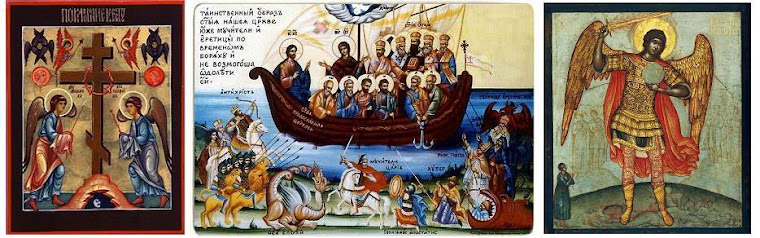
On Divine and Deceptive Sweetness

Saint Diadochos of Photiki. "On Spiritual Knowledge and Discrimination. One Hundred Texts". From Philokalia, Vol. 1.

31. When our intellect begins to perceive the grace of the Holy Spirit, then Satan, too, importunes the soul with a sense of deceptive sweetness in the quiet times of the night, when we fall into a light kind of sleep. If the intellect at that time cleaves fervently to the remembrance of the glorious and holy name of the Lord Jesus and uses it as a weapon against Satan's deception, he gives up this trick and for the future will attack the soul directly and personally. As a result the intellect clearly discerns the deception of the evil one and advances even further in the art of discrimination.
32. The experience of true grace comes to us when the body is awake or else on the point of falling asleep, while in fervent remembrance of God we are welded to His love. But the illusion of grace comes to us, as I have said, when we fall into a light sleep while our remembrance of God is half-hearted. True grace, since its source is God, gladdens us consciously and impels us towards love with great rapture of soul. The illusion of grace, on the other hand, tends to shake the soul with the winds of deceit; for when the intellect is strong in the remembrance of God, the devil tries to rob it of its experience of spiritual perception by taking advantage of the body's need for sleep. If the intellect at that time is remembering the Lord Jesus attentively, it easily destroys the enemy's seductive sweetness and advances joyfully to do battle with him, armed not only with grace but also with a second weapon, the confidence gained from its own experience.
33. Sometimes the soul is kindled into love for God and, free from all fantasy and image, moves untroubled by doubt towards Him; and it draws, as it were, the body with it into the depths of that ineffable love. This may occur when the person is awake or else beginning to fall asleep under the influence of God's grace, in the way I have explained. At the same time, the soul is aware of nothing except what it is moving towards. When we experience things in this manner, we can be sure that it is the energy of the Holy Spirit within us. For when the soul is completely permeated with that ineffable sweetness, at that moment it can think of nothing else, since it rejoices with uninterrupted joy. But if at that moment the intellect conceives any doubt or unclean thought, and if this continues in spite of the fact that the intellect calls on the holy name -not now simply out of love for God, but in order to repel the evil one - then it should realize that the sweetness it experiences is an illusion of grace, coming from the deceiver with a counterfeit joy. Through this joy, amorphous and disordered, the devil tries to lead the soul into an adulterous union with himself. For when he sees the intellect unreservedly proud of its own experience of spiritual perception, he entices the soul by means of certain plausible illusions of grace, so that it is seduced by that dank and debilitating sweetness and fails to notice its intercourse with the deceiver. From all this we can distinguish between the Spirit of truth and the spirit of error. It is impossible, however, for someone consciously to taste the divine goodness or consciously to realize when he is experiencing the bitterness of the demons, unless he first knows with assurance that grace dwells in the depths of his intellect, while the wicked spirits cluster round only the outside of the heart. This is just what the demons do not want us to know, for fear that our intellect, once definitely aware of it, will arm itself against them with the remembrance of God.

On False Revelations

Alexei Ilyich Osipov. "Individual Revelation and Its Indications".

Translated by Nun Cornelia

A question of no less importance would also be about the truth of those religious experiences, phenomena, and revelations that a religious person could have. This question concerns the understanding of the existence of spiritual life and a conditional knowledge of the ”other” world, because any mistake in this matter is always bound with great danger: he who does not enter into it by the door will be consigned to the lot of a thief and robber! (see Jn 10:1). Curiosity, fantasy, and insobriety in this realm, or attempts to penetrate the spiritual world by any means, are tantamount to suicide. It is well known, for example, that those who have actively been involved in spiritualism have as a rule ended their lives in suicide, or at least in total psychological disorder. All other forms of occultism bring a person to the same end.[1]

Such unlawful penetration into the spiritual world is dangerous in the highest extreme, especially since it inevitably stimulates false revelations, which draw in inexperienced people who are unacquainted with the basics of spiritual life, and destroys them spiritually and physically.[2] Two obvious examples of such ”revelations” [in Russia] are those of the ”Theotokos Center,” or the ”White Brotherhood,” whose outrageous totalitarianism in their interpretation of Christianity speaks eloquently of the nature and worthiness of these ”revelations.”[3]
What is needed for the ”discernment of spirits” according to the Orthodox teaching? Saint Ignatius (Brianchaninov) gives a thorough and precise answer to this question in his article, ”A Word on Sensual and Spiritual Vision of Spirits.”[4] We will note here the more essential thoughts in this article.

Saturday, January 28, 2012

The Elder Reveals Concealed Sins

Episode from the life of Saint Barsanuphius of Optina.

Saint Barsanuphius of Optina (1845 - 1913)
Here are the astounding memoirs about confession to the elder left by his spiritual daughter:
- We reached the skete, the Devil in every way distracted me and suggested to leave, but having crossed myself, I firmly entered the hut ... I made a sign of the cross before the icon of the Queen of Heaven and froze.
The Father entered, I was standing in the middle of his cell ... The Father came up to the Tikhvin icon of God’s Mother and sat ...
- Come closer.
I timidly approached him.
- Kneel down, my child ... It is accepted here that we sit and confessants stand on the knees near us because of humility.
I dropped down, not just kneeled... The Father took me by both shoulders, looked at me infinitely kindly, as no one has ever looked, and said:
- My dear child, my sweet child, my precious child! Are you twenty-six?
- Yes, Father.
- You are twenty-six, how many years were you fourteen years ago?
I thought a moment and answered:
- Twelve.
- True, and since that year you have begun concealing sins at the confession.
Do you want me to tell you them?

- Tell, Father, - I replied timidly.
And then the Farther began to name my sins for the previous years and even months as if he was reading them from an open book...

Elder Daniel Cures Spiritual Delusion


Archimandrite Cherubim. "Contemporary Ascetics of Mount Athos".

Elder Daniel Katounakiotis: Stories of Apocalyptic and Demonic Delusions.

Extracted from the book and published in the blog by John Sanidopoulos.
http://www.johnsanidopoulos.com/2010/09/elder-daniel-katounakiotis-stories-of.html

Elder Daniel
Endowed with uncommon intelligence and thirsting for learning, Elder Daniel (+1929) had devoured the patristic books and plundered the treasures of the Spirit. Many monks who had fallen into various delusions through ignorance or a spirit of pride were saved by the intervention of Elder Daniel. Like his namesake, the Prophet Daniel, he in truth possessed "an excellent spirit, and knowledge, and understanding, interpreting dreams ... and dissolving doubts" (Daniel 5:12).

Deluded Demos, For Whom Demons Danced


A good Christian of simple faith named Demos, a builder by profession, lived in Stika of Northern Epirus. One night he dreamt that in a certain place there was a church buried in the earth. Rousing his compatriots, therefore, they brought shovels and pickaxes and began the excavation. The church was brought to light. Full of satisfaction, Demos took pride in his success and pleasure in everyone's wonder; and when the cunning thought whispered to him, "Now, Demos, you are an important man, you have been chosen by God...," he accepted it without disputation.

A while later he was exercising his trade as builder on the Holy Mountain, working on a certain construction project of Vatopaidi Monastery.

In Vatopaidi St. Evdokimos is very much revered. Nothing has been preserved about his life, but in 1840, by God's providence, his relics were miraculously revealed in the cemetery of the Monastery. Demos displayed great devotion to him, and began to believe that the Saint also regarded him with particular favor. Since the tradition said nothing about his extraction, Demos imagined that he had come from Albania.

"The Saint is an Albanian, like myself," he began to declare.

"But how do you know?"

"An Albanian he is. Don't you see that his head is flat? Besides, one night I was begging him on my prayer-rope to tell me his fatherland, and he appeared to me as though he were alive. 'I am an Albanian, from Stika; we are even relatives...' he said."

The fathers suspected that he had been deceived by a demon.
"When he appears to you again, make the sign of the Cross," they told him. "If it is the work of the evil one, he will disappear immediately."

It was too late, however. The demon had conquered Demos' heart and would not readily leave.

Danger of Delusion when Practicing the Jesus Prayer

Hieromonk Adrian (Pashin). “The Way of a Pilgrim” and Bishop Ignatius (Brianchaninov’s) Teaching on Prayer".

Basing himself on the legacy of St Ignatius of the Caucasus, Alexey Ilyich Osipov, the well-known Professor of the Moscow Theological Academy, reflects on the issues of spiritual practices in Eastern and Western Christian traditions, as well as the place of the book The Way of a Pilgrim in Christian spiritual life.
Hieromonk Adrian (Pashin): Alexey Ilyich, your booklet on the Jesus Prayer was published recently. What prompted you to tackle this exclusively (as it might seem) monastic subject?
Alexey Ilyich Osipov: The thing is that I was invited to give a lecture in Italy, at the famous Bose monastery, where they hold conferences on various topics every year. Representatives of different Churches are invited – not only from the Catholic Church, but from the Orthodox and even the Protestant Churches as well. That was in September 2004. The topic of the conference was prayer and, I think, even the Jesus Prayer, but I don’t remember for sure. How did the theme for my talk come up? The Chancellor of one of the Pontifical Institutes in Rome visited our Academy about twenty years ago. During his talk in the conference hall he said, in particular, that Catholic monastics are currently very interested in Hindu meditation practices and The Way of a Pilgrim, where a quite peculiar teaching on the Jesus Prayer is expounded. That is why I decided to write a talk on the subject of “The Teaching on the Jesus Prayer according to Bishop Ignatius (Brianchaninov) and The Way of a Pilgrim”. I thought that the subject would be of interest both to Catholics and to me because I had read The Way when I was 16 or 17 and it had made a very inspirational impression on me back then. I remember trying to practice the Jesus Prayer for a day or two, using the Pilgrim’s method – I could not do it for much longer; later, when I took up work on my talk, I understood that that had been fortunate. I gave my talk at the conference. The Orthodox showed interest while the Catholic audience received it in silence. However, one of the famous (I am not going to name him) secular scholars from St Petersburg (not a theologian), a regular participant at all the Bose conferences, expressed his displeasure at my talk. The talk was then translated into Italian and published both in Italy and Russia. Such is its background.

On Sectarianism

Metropolitan Anthony (Krapovitsky). "Confession".

10. Spiritual Delusion (Prelest).

Metropolitan Anthony (Krapovitsky)
Weak faith and carelessness are expressions of people’s irreligion, but even a pious person is not protected from spiritual sickness if he does not have a wise guide, either a living person or a spiritual writer. This sickness is called prelest, or spiritual delusion, imagining oneself to be near to God and to the realm of the divine and supernatural. Even zealous ascetics in monasteries are sometimes subject to this delusion, but of course, lay people who are zealous in outward ascetic struggles undergo it much more frequently. Surpassing their acquaintainces in feats of prayer and fasting, they imagine that they are seers of divine visions, or at least of dreams inspired by grace. In all events in their lives they see special, intentional directions from God or their Guardian Angel, and then they start imagining that they are God’s elect, and not infrequently try to foretell the future. The Holy Fathers armed themselves against nothing so fiercely as against this sickness — spiritual delusion.

Prelest endangers a man’s soul if it lurks in him alone; but it is dangerous and imperilling also for the whole of local church life, if a whole society is seized in its grasp, if it makes its appearance anywhere as a spiritual epidemic and the life of a whole parish or diocese is oriented entirely towards it. This is exactly what has happened in the Russian Church, both in Great Russia and in the Ukraine, both among the simple people and in the so-called "enlightened society." This plague, under various names, began to develop in strength throughout the local Russian Church some thirty years ago, and by the time of the last war it had seized almost all parts of the former Russian Empire in its grasp. In St. Petersburg, in Moscow and on the lower reaches of the Volga appeared the Johannites, who declared the late Fr. John of Kronstadt to be a reincarnation of Christ and a certain Matrona Kisileva to be the Mother of God. To replace one Christ, others appeared — Chursikov in Petrograd, Koloskov in Moscow and Samara, and so on. The Ukraine created Stephan Podgorny, a wanderer who later became a monk and claimed to be God. Podolia and Bessarabia declared a semi-literate and drunken Moldavian hieromonk, Innokenty, to be Christ. In Kiev another uneducated monk called Spiridon, who had attained to the rank of archimandrite during the war, started to preach a new faith. In Siberia Johannism took on an especially fanatical character, and, alas, even on Mt. Athos an extremely harmful movement of delusion, called imenobozhnichestvo, has started spreading.

On Mysticism of Francis of Assisi

Fr. George Macris. "A Comparison of the Mysticism of Francis of Assisi With That of St. Seraphim of Sarov".


Originally printed in Synaxis: Orthodox Christian Theology in the 20th Century, Vol. 2, pp. 39-56.
During my prayer two great lights appeared before me (deux grandes lumibres m'ont ete montrees) — one in which I recognized the Creator, and another in which I recognized myself.
— Francis' own words about his prayer

The truly righteous always consider themselves unworthy of God.
— Dictum of St. Isaac the Syrian

Studying the biographical data of Francis of Assisi, a fact of the utmost interest concerning the mysticism of this Roman Catholic ascetic is the appearance of stigmata on his person. Roman Catholics regard such a striking manifestation as the seal of the Holy Spirit. In Francis' case, these stigmata took the form of the marks of Christ's passion on his body.

The stigmatisation of Francis is not an exceptional phenomenon among ascetics of the Roman Catholic world. Stigmatisation appears to be characteristic of Roman Catholic mysticism in general, both before it happened to Francis, as well as after. Peter Damian, as an example, tells of a monk who bore the representation of the Cross on his body. Caesar of Geisterbach mentions a novice whose forehead bore the impress of a Cross. [1] Also, a great deal of data exists testifying to the fact that after Francis' death a series of stigmatisations occurred which, subsequently, have been thoroughly studied by various investigators, particularly in recent times. These phenomena, as V. Guerier says, illuminate their primary source. Many of them were subjected to careful observation and recorded in detail, e.g., the case of Veronica Giuliani (1660-1727) who was under a doctor's observation; Luisa Lato (1850-1883) described by Dr Varleman, [2] and Madelaine N. (1910) described by Janat. [3]

Signs of Grace and Delusion

St. Gregory of Sinai (~1275 - 1346)

Saint Gregory of Sinai. "On the Signs of Grace and Delusion, Written for the Confessor Longinos: Ten Texts". From Philokalia, Vol. 4.

1. As the great teacher St John Chrysostom states, we should be in a position to say that we need no help from the Scriptures, no assistance from other people, but are instructed by God; for 'all will be taught by God' (Isa. 54:13; John 6:45), in such a way that we learn from Him and through Him what we ought to know. And this applies not only to those of us who are monks but to each and every one of the faithful: we are all of us called to carry the law of the Spirit written on the tablets of our hearts (cf. 2 Cor. 3:3), and to attain like the Cherubim the supreme privilege of conversing through pure prayer in the heart directly with Jesus. But because we are infants at the time of our renewal through baptism we do not understand the grace and the new life conferred upon us. Unaware of the surpassing grandeur of the honor and glory in which we share, we fail to realize that we ought to grow in soul and spirit through the keeping of the commandments and so perceive noetically what we have received. On account of this most of us fall through indifference and servitude to the passions into a state of benighted obduracy. We do not know whether God exists, or who we are, or what we have become, although through baptism we have been made sons of God, sons of light, and children and members of Christ. If we are baptized when grown up, we feel that we have been baptized only in water and not by the Spirit. And even though we have been renewed in the Spirit, we believe only in a formal, lifeless and ineffectual sense, and we say we are full of doubts. Hence because we are in fact non-spiritual we live and behave in a non-spiritual manner. Should we repent, we understand and practice the commandments only in a bodily way and not spiritually. And if after many labors a revelation of grace is in God's compassion granted to us, we take it for a delusion. Or if we hear from others how grace acts, we are persuaded by our envy to regard that also as a delusion. Thus we remain corpses until death, failing to live in Christ and to be inspired by Him. According to Scripture, even that which we possess will be taken away from us at the time of our death or our judgment because of our lack of faith and our despair (cf. Matt. 25:29). We do not understand that the children must be like the father, that is to say, we are to be made gods by God and spiritual by the Holy Spirit; for 'that which is born of the Spirit is spirit' (John 3:6). But we are unregenerate, even though we have become members of the faith and heavenly, and so the Spirit of God does not dwell within us (cf. Gen. 6:3). Because of this the Lord has handed us over to strange afflictions and captivity, and slaughter flourishes, perhaps because He wishes to correct evil, or cut it off, or heal it by more powerful remedies.

Difference Between Grace and Delusion: Grace is Light

Saint Seraphim of Sarov. "On Acquisition of the Holy Spirit".

"And I must further explain, your Godliness, the difference between the operations of the Holy Spirit Who dwells mystically in the hearts of those who believe in our Lord God and Savior Jesus Christ and the operations of the darkness of sin which at the suggestion and instigation of the devil, acts predatorily in us. The Spirit of God reminds us of the words of our Lord Jesus Christ and always acts triumphantly with Him, gladdening our hearts and guiding our steps into the way of peace, while the false, diabolical spirit reasons in the opposite way to Christ, and its actions in us are rebellious, stubborn, and full of the lust of the flesh, the lust of the eyes and the pride of life.

"And whoever lives and believes in Me will never die" (John 11:26). He who has the grace of the Holy Spirit in reward for right faith in Christ, even if on account of human frailty his soul were to die for some sin or other, yet he will not die for ever, but he will be raised by the grace of our Lord Jesus Christ "Who takes away the sin of the world" (John 1:29), and freely gives grace upon grace. Of this grace, which was manifested to the whole world and to our human race by the God-man, it is said in the Gospel: "In Him was life, and the life was the light of men" (John 1:4); and further: "And the light shines in the darkness; and the darkness has never swallowed it" (John 1:5). This means that the grace of the Holy Spirit which is granted at baptism in the name of the Father and the Son and the Holy Spirit, in spite of man's fall into sin, in spite of the darkness surrounding our soul, nevertheless shines in our hearts with the divine light (which has existed from time immemorial) of the inestimable merits of Christ. In the event of a sinner's impenitence this light of Christ cries to the Father: "Abba, Father! Be not angry with this impenitence to the end (of his life)." Then, at the sinners conversion to the way of repentance, it effaces completely all trace of past sin and clothes the former sinner once more in a robe of incorruption spun from the grace of the Holy Spirit. The acquisition of this is the aim of the Christian life, which I have been explaining to your Godliness.

"I will tell you something else, so that you may understand more clearly what is meant by the grace of God, how to recognize it and how its action is manifested particularly in those who are enlightened by it. The grace of the Holy Spirit is the light which enlightens man. The whole of Sacred Scripture speaks about this. Thus our Holy Father David said: "Thy law is a lamp to my feet, and a light to my paths" (Ps. 118[119]:105), and "Unless Thy law had been my meditation, I should have died in my humiliation" (Ps. 118[119]:92). In other words, the grace of the Holy Spirit which is expressed in the Law, by the words of the Lord's commandments, is my lamp and light. If this grace of the Holy Spirit (which I try to acquire so carefully and zealously that I meditate on Thy just judgments seven times a day) did not enlighten me amidst the darkness of the cares which are inseparable from the high calling of my royal rank, whence should I get a spark of light to illumine my way on the path of life, which is darkened by the ill-will of my enemies?

"In fact the Lord has frequently demonstrated before many witnesses how the grace of the Holy Spirit acts on people whom He has sanctified and illumined by His great inspirations. Remember Moses after his talk with God on Mount Sinai. He so shone with an extraordinary light that people were unable to look at him. He was even forced to wear a veil when he appeared in public. Remember the Transfiguration of the Lord on Mount Tabor. A great light encircled Him, "and His raiment became shining, exceedingly white like snow" (Mk. 9:3), and His disciples fell on their faces from fear. But when Moses and Elijah appeared to Him in that light, a cloud overshadowed them in order to hide the radiance of the light of the divine grace which blinded the eyes of the disciples. Thus the grace of the All-Holy Spirit of God appears in an ineffable light to all to whom God reveals its action."

Spiritual Discernment in the Orthodox Tradition

Nun Macaria. "The Angel of Light and Spiritual Discernment in the Orthodox Tradition" –an Epiphany Journal Reprint.

The knight in John Keats’ poem, La Belle Dame Sans Merci, with his fatally naive fascination for the supernatural, has much in common with today’s spiritual seeker. The knight is described as being «at-arms,» that is, prepared for battle or for some high adventure. Had he been specifically intent on romance he might have been dressed differently. He was not prepared for the kind of adventure he encountered: he did not recognize the enemy. He had a supernatural vision which was beautiful and enticing but it did not occur to him that such a vision could be harmful. When the true nature of the vision was revealed, it was too late for him. The poet implies that the youth has received a fatal, invisible wound. This fascination with the supernatural and with fair-seeming, hostile spirits was a favorite theme for the Romantic poets, as it is in our time. In both cases there has been a rejection of materialism in favor of the supernatural but without any leavening of discernment. In fact, the contemporary world has no standard or guideline for discernment. It represents a plurality of world views in which the only common understanding is that there is no truth. Even modern Christianity is ill-equipped for this task, cut off as it is from the grace and wisdom of holy Tradition. If we wish to find practical, experiential knowledge of the spiritual world, and in particular about the discernment of spirits, we need to turn to the writings of the Holy Fathers and the Saints of the Orthodox Church. We will find a harmony and consistency in these many voices of experience, from the earliest days of the Church until our own.

Two Forms and Three Sources of Delusion

Saint Gregory of Sinai. "On Commandments and Doctrines, Warnings and Promises; On Thoughts, Passions and Virtues, and Also on Stillness and Prayer: One Hundred and Thirty-Seven Texts". From Philokalia, Vol. 4.

131. Here something must be said about delusion, so far as this is possible; for, because of its deviousness and the number of ways in which it can ensnare us, few recognize it clearly and for most it is almost inscrutable. Delusion manifests itself or, rather, attacks and invades us in two ways - in the form of mental images and fantasies or in the form of diabolic influence - though its sole cause and origin is always arrogance. The first form is the origin of the second and the second is the origin of a third form - mental derangement. The first form, illusory visions, is caused by self-conceit; for this leads us to invest the divine with some illusory shape, thus deceiving us through mental images and fantasies. This deception in its turn produces blasphemy as well as the fear induced by monstrous apparitions, occurring both when awake and when asleep - a state described as the terror and perturbation of the soul. Thus arrogance is followed by delusion, delusion by blasphemy, blasphemy by fear, fear by terror, and terror by a derangement of the natural state of the mind. This is the first form of delusion, that induced by mental images and fantasies. The second form, induced by diabolic influence, is as follows. It has its origin in self-indulgence, which in its turn results from so-called natural desire. Self-indulgence begets licentiousness in all its forms of indescribable impurity. By inflaming man's whole nature and clouding his intelligence as a result of its intercourse with spurious images, licentiousness deranges the intellect, searing it into a state of delirium and impelling its victim to utter false prophecies, interpreting the visions and discourses of certain supposed saints, which he claims arc revealed to him when he is intoxicated and befuddled with passion, his whole character perverted and corrupted by demons. Those ignorant of spiritual matters, beguiled by delusion, call such men 'little souls'. These 'little souls' are to be found sitting near the shrines of saints, by whose spirit they claim to be inspired and tested, and whose purported message they proclaim to others. But in truth they should be called possessed by the demons, deceived and enslaved by delusion, and not prophets foretelling what is to happen now and in the future. For the demon of licentiousness himself darkens and deranges their minds, inflaming them with the fire of spiritual lust, conjuring up before them the illusory appearance of saints, and making them hear conversations and see visions. Sometimes the demons themselves appear to them and convulse them with fear. For having harnessed them to the yoke of Belial, the demon of licentiousness drives them on to practice their deceits, so that he may keep them captive and enslaved until death, when he will consign them to hell.
132. Delusion arises in us from three principal sources: arrogance, the envy of demons, and the divine will that allows us to be tried and corrected. Arrogance arises from superficiality, demonic envy is provoked by our spiritual progress, and the need for correction is the consequence of our sinful way of life. The delusion arising solely from envy and self-conceit is swiftly healed, especially when we humble ourselves. On the other hand, the delusion allowed by God for our correction, when we are handed over to Satan because of our sinfulness, God often permits to continue until our death, if this is needed to efface our sins. Sometimes God hands over even the guiltless to the torment of demons for the sake of their salvation. One should also know that the demon of self-conceit himself prophesies in those who are not scrupulously attentive to their hearts.

A Monk Made 3000 Prostrations a Day

Archimandrite Cherubim. "Contemporary Ascetics of Mount Athos".

The Deluded "Super-Ascetic" Who Made 3,000 Prostrations A Day.

When Elder Daniel Katounakiotis (+1929) was in the Russian Monastery, he observed that a certain monk living in asceticism in a kathisma outside the Monastery played a role of a great ascetic. He fasted severely, wore the most wretched clothes, walked around barefoot even in winter, etc. Among other things, while the rule called for 300 prostrations a day, he made 3000. For this reason the other monks marvelled at him.

Elder Daniel, even though he was younger at the time, displayed no enthusiasm. His clear-sighted eyes discerned a situation that was not pleasing to God. He noticed that the door of his kathisma contained an opening which allowed the passers-by to look in and praise his great asceticism.
His love moved him to report the situation to the abbot, and thus save the brother from delusion. The abbot set out for the kathisma of the "super-ascetic".

"How are you doing here, father?"

"By your prayers, Elder, well. I struggle and weep over my sins."

"Only you never come to tell me your thoughts."

"What could I tell you, Elder? You know them all. I am a sinner who struggles."

"How do you struggle? Tell me, do you make prostrations?"

"Yes, Elder, I make a few."

"How many?"

"By your prayers, 3000 a day."

"What! Why 3000? Who gave you a blessing to do so many? No, don't ever do 3000 again. What are you trying to portray - a 'super-ascetic'? From now on do only fifty, so you won't get proud."

With that the abbot left. The incision had been made, and the abscess soon revealed its foul contents. For the former "great ascetic" made a 180-degree turn. He was unable to make even fifty prostrations. Instead of ragged clothes he now wore whatever was most expensive, and had the choicest foods brought to his poor table. Naturally, the other fathers were astonished, and they understood that his excessive ascetic practices had been fed by the spirit of pride. This explained this surprising change, for the spirit of delusion runs after extremes. According to patristic wisdom, the extreme, the superfluous, and the excessive are "of the demons".

A Virgin Fell with a Man Because of Her Pride

Bishop Palladius. "The Lausiac History".

Chapter XXVIII.  A virgin who fell

Again, I knew a virgin in Jerusalem who wore sackcloth for six years and shut herself up in a cell, taking none of the things that bestow pleasure. In the end she fell, abandoned (by God) because of her excessive arrogance. She opened the window and admitted the man who waited on her and sinned with him, because she had practised asceticism not with a religious motive and for the love of God, but with human ostentation, which springs from vain-glory and corrupt intention. For, her thoughts being engrossed in condemning others, the guardian of her chastity was absent.

A Monk Prayed not to See Any Visions

Saint Nicolai Velimirovich. "The Prologue."

The spiritists of our time accept every appearance from the spiritual world as sent by God and immediately boast that it has been 'revealed' to them. I was myself acquainted with an eighty-year-old monk who was respected by everyone as a great spiritual guide. When I asked him if he had ever seen any being from the spiritual world in his lifetime, he answered me: 'No, never; and praise be to God for his mercy!' Seeing my astonishment at this, he said: 'I have constantly prayed to God that nothing should ever appear to me, lest I fall into illusion and accept a devil disguised as an angel. And, until now, God has heard my prayer.

A False Angel Told a Man to Sacrifice His Son

Saint John Cassian. "Conferences".

The Second Conference of Abbot Moses. On Discretion.

Chapter VII. Of an illusion into which another fell for lack of discretion.

Why also should I speak of one (whose name we had rather not mention as he is still alive), who for a long while received a devil in the brightness of an angelic form, and was often deceived by countless revelations from him and believed that he was a messenger of righteousness: for when these were granted, every night he provided a light in his cell without the need of any lamp. At last he was ordered by the devil to offer up to God his own son who was living with him in the monastery, in order that his merits might by this sacrifice be made equal to those of the patriarch Abraham. And he was so far seduced by his persuasion that he would really have committed the murder unless his son had seen him getting ready the knife and sharpening it with unusual care, and looking for the chains with which he meant to tie him up for the sacrifice when he was going to offer him up; and had fled away in terror with a presentiment of the coming crime.

Various Kinds of Delusion Including False Vision of the Cross

St. Macarius of Optina.

Extractions from the Letters of Saint Elder Macarius of Optina.

2. Illusions

It is dangerous to assume that our dreams are revelations: this leads to spiritual pride. Ponder calmly: is it likely that a heart and mind, both fully under the influence of all the wildest human passions, can truly mirror divine revelations? Does not such an assumption betray undue reliance on your own worthiness? For who can esteem himself worthy of such grace? [268]

You yourself have perfectly described the reason of your woe. First, your education. This, although Christian in theory, did not lead you to a Christian life in practice. Secondly, your early life ran exceptionally smoothly, without any of those temptations and afflictions which-when wrestled with or accepted in the right way-can make true Christians of us. Indeed, when you were a child and when you first grew up, worldlings showered on you much flattery, adulation, and praise. Thus encouraged and helped, unhealthy illusions concerning your importance, superiority, and goodness steadily poisoned your heart, so that even before the cruder passions beset you, pride and a hard self-esteem had built up a sound foundation for your woes.

God resists the proud; He allows them to be humbled by manifold chastisements and by the scorching torments of passion. Your insisting on separation from your first husband was a proof of the hold lusts and passions had gained over you. And, although the situation which naturally ensued could not flatter your pride, it was your pride that had forced the situation.
Then the tentacles of chastisement closed around you! Not only did the fires of a stricken conscience torment you, but, gradually, trifling worries, pin-pricks, annoyances accumulated into a great weight that crushed you, and flattened you out. Still wishing to stamp your will on all around you, you grew agitated and distressed. This agitation and distress, far from acting as a balm to your passions, exasperated them until, at last, your suspicions and jealousy affected your mind.

Pride After a False Vision of Jesus Christ

Bishop Palladius. "The Lausiac History".

Chapter XXV.  Valens.

There was a man named Valens, a Palestinian by race, but Corinthian in his character - for St. Paul attributed the vice of presumption to the Corinthians. Having taken to the desert he dwelt with us for a number of years. He reached such a pitch of arrogance that he was deceived by demons. For by deceiving him little by little they induced him to be very proud, supposing that angels met him. 
One day at least, so they told the tale, as he was working in the dark he let drop the needle with which he was stitching the basket. And when he did not find it, the demon made a lamp, and he found the needle. Again, puffed up at this, he waxed proud and in fact was so greatly puffed up that he despised the communion of the mysteries. Now it happened that certain strangers came and brought sweetmeats to the Church for the brethren. 
So the holy Macarius our priest received them and sent a handful or so to each of us in his cell, among the rest also to Valens. When Valens received the bearer he insulted him and struck him and said to him: "Go and tell Macarius, 'I am not worse than you, that you should send me a blessing.' So Macarius, knowing that he was the victim of illusion, went the next day to exhort him and said to him: "Valens, you are the victim of illusions. Stop it." And when he would not listen to his exhortations, he retired. So the demon, convinced that he was completely persuaded by his deception, went away and disguised himself as the Saviour, and came by night in a vision of a thousand angels bearing lamps and a fiery wheel, in which it seemed that the Saviour appeared, and one came in front of the others and said: "Christ has loved you because of your conduct and the freedom of your life, and He has come to see you. So go out of the cell, do nothing else but look at his face from afar, stoop down and worship, and then go to your cell." 
So he went out and saw them in ranks carrying lamps, and antichrist about a stade away, and he fell down and worshipped. Then the next day again he became so mad that he entered into the church and before the assembled brotherhood said: "I have no need of Communion, for I have seen Christ to-day." Then the fathers bound him and put him in irons for a year and so cured him, destroying his pride by their prayers and indifference and calmer mode of life. As it is said, "Diseases are cured by their opposites."

The Devils of Vainglory Do Their Prophecies in Dreams

Saint John Climacus. "The Ladder of Divine Ascent". Step 3.

Concerning the dreams of novices

Our mind is the instrument of knowledge, but it is very imperfect and filled with all sorts of ignorance. This is a fact that cannot be disguised.
Now the palate discriminates between various kinds of food, the hearing distinguishes between the things it perceives, the sun shows up the weakness of the eyes, and words reveal the ignorance of a soul. Nevertheless, the law of love urges us to reach beyond ourselves, and so it seems to me—and I do not wish to be insistent—that, immediately after this discussion of exile, or rather, in the course of it, something ought to be said about dreams. For we should not be unaware of this type of deceit practiced by our wily enemies.
A dream is a stirring of the mind during the body's rest, while a fantasy is something that tricks the eyes whCii the intellect is asleep. Fantasy occurs when the mind wanders, while the body is awake. A fantasy is the contemplation of something that does not actually exist.
It must be clear why I have decided to speak here about dreams. After we leave home and family for the sake of the Lord, after we have gone into exile for the love of God, the demons try to shake us with dreams. They show us our relatives grieving, near death, poverty-stricken or imprisoned because of us. But the man who believes in dreams is like someone running to catch up with his own shadow.
The devils of vainglory do their prophecies in dreams. They guess the future and, as part of their deceit, they inform us of it so that we are astonished to discover our visions coming true. Indeed we get carried away with the notion that we are already close to the gift of foreknowledge.
To the credulous, a devil is a prophet; and to those who despise him, he is just a liar. Because he is a spiritual being, he knows what is happening in the lower regions, that someone is dying, for instance, so by way of dreams he passes the information on to the more gullible. However, demons lack actual foreknowledge. If they did not, these tricksters would be able to foretell our deaths.
Devils often take on the appearance of angels of light or martyrs and they appear to us in sleep and talk to us, so that they can push us into unholy joy and conceit when we wake up. But this very effect will reveal their trick, for what angels actually reveal are torments, judgments, and separation, with the result that on waking up we tremble and are miserable. And if we start to believe in the devils of our dreams, then we will be their playthings when we are also awake.
The man who believes in dreams shows his inexperience, while the man who distrusts every dream is very sensible. Trust only the dreams that foretell torments and judgment for you, but even these dreams may also be from demons if they produce despair in you.

http://oprelesti.ru/index.php/kinds-of-spiritual-delusion/135-trust-in-dreams/271-the-devils-of-vainglory-do-their-prophecies-in-dreams

What Happens if a Priest Has a Mortal Sin and Serves Liturgy

Bishop Palladius. "The Lausiac History".

Chapter XVIII.  Macarius of Alexandria
Once I visited this holy Macarius and found a village priest lying just outside his cell, whose head was all eaten away by the disease called cancer, and the actual bone appeared on the crown of his head. He had come to be healed and Macarius would not grant him an interview. So I besought him: "I pray you, pity him and give him his answer." And he said to me: "He does not deserve to be healed, for it has been sent him as a punishment. But if you want him to be healed, persuade him to give up taking services. For he was taking services, though living in fornication, and for this reason he is being punished and God is healing his soul." So when I said this to the afflicted man he consented, and swore that he would no longer exercise his priesthood. Then he received him and said: "Do you believe that God is?" He said to him: "Yes." "Were you able to mock God?" "No," he answered. He said: "If you recognize your sin and the chastening of God, on account of which you suffered this, reform yourself henceforward." So he confessed his fault and gave a promise that he would sin no more nor take the service, but embrace the position of a layman. Then he laid his hands on him and in a few days he was cured and the hair grew and he went away healed.

What is of God, comes of Itself, Without You Knowing When it Will Come

St Gregory of Sinai. "On Stillness: Fifteen Texts. Different Ways of Psalmodizing." From Philokalia, Vol. 4.

10. So, lover of God, attend with care and intelligence. If while engaged in spiritual work you see a light or a fire outside you, or a form supposedly of Christ or of an angel or of someone else, reject it lest you suffer harm. And do not pay court to images, lest you allow them to stamp themselves on your intellect. For all these things that externally and inopportunely assume various guises do so in order to delude your soul. The true beginning of prayer is the warmth of heart that scorifies the passions, fills the soul with joy and delight, and establishes the heart in unwavering love and unhesitating surety. The holy fathers teach that if the heart is in doubt about whether to accept something either sensory or conceptual that enters the soul, then that thing is not from God but has been sent by the devil. Moreover, if you become aware that your intellect is being enticed by some invisible power either from the outside or from above, do not trust in that power or let your intellect be so enticed, but immediately force it to continue its work. Unceasingly cry out: ‘Lord Jesus Christ, Son of God, have mercy’, and do not allow yourself to retain any concept, object, thought or form that is supposedly divine, or any sequence of argument or any color, but concentrate solely on the pure, simple, formless remembrance of Jesus. Then God, seeing your intellect so strict in guarding itself in every way against the enemy, will Himself bestow pure and unerring vision upon it and will make it participate in God and share in all other blessings.
What is of God, says St Isaac, comes of itself, without you knowing when it will come. Our natural enemy - the demon who operates in the seat of our desiring power - gives the spirit-forces various guises in our imagination. In this way he substitutes his own unruly heat for spiritual warmth, so that the soul is oppressed by this deceit. For spiritual delight he substitutes mindless joy and a muggy sense of pleasure, inducing selfsatisfaction and vanity. Thus he tries to conceal himself from those who lack experience and to persuade them to take his delusions for manifestations of spiritual joy. But time, experience and perspicacity will reveal him to those not entirely ignorant of his wiles. As the palate discriminates between different kinds of food (cf. Eccles. 36:18,19), so the spiritual sense of taste clearly and unerringly reveals everything as it truly is.

Protect Yourself from Liking or Disliking a Thing out of Passion

Lorenzo Scupoli, enhanced by Saint Nicodemus of the Holy Mountain, and Saint Theophan the Recluse. "Unseen Warfare".

St. Theophan the Recluse
The reason why we have wrong judgment of the things we mentioned earlier is that we do not look deeply into them to see what they are, but conceive a liking for them or a dislike of them from the very first glance, judging by appearances. These likes and dislikes prejudice our mind and darken it; and so it cannot form a. right judgment of things as they really are. So, my brother, if you wish to be free of this prelest in your mind, keep strict attention over yourself; and when you see a thing with your eyes, or visualise it in your mind, keep a firm grip on your desires and do not allow yourself at the first glance either to conceive a liking for the thing or a dislike for it, but examine it in a  detached way with the mind alone. Unobscured by passion, the mind then remains in a state natural to it, which is free and pure, and has the possibility to know the truth and to penetrate into the depths of a thing, where evil is often concealed under a deceptively attractive exterior and where good is sometimes hidden under a bad appearance.
But if desire comes first and at once either likes a thing or turns away from it, your mind no longer has the possibility to know it rightly as it should. For if this predisposition, or rather this passion precedes every judgment, it enters within, becomes a wall between the mind and the thing and, obscuring the mind, makes it form its judgment from passion. In other words, it sees it not as it really is, which strengthens still more its original predisposition. The further this predisposition runs ahead, or the more it likes or dislikes a thing, the more it obscures the mind in relation to it, until it darkens the mind completely. Then passion in relation to this thing reaches its ultimate limits, so that it appears to a man either as the most desirable or the most hateful of all the things he ever liked or disliked. Thus it happens that when the rule I have indicated is not observed, that is, when desire is not restrained from forming likes and dislikes before a thing is properly examined, then both these powers of the soul—mind and will—always work wrongly, plunging ever deeper and deeper from darkness to darkness, and from sin to sin.
So watch, my beloved, with all attention and protect yourself from liking or disliking a thing out of passion, before you have had time to examine it properly in the light of reason and the just word of the Divine Scriptures, in the light of grace and prayer, and with the help of the judgment of your spiritual father; otherwise you may sin in taking for evil what is truly good, and for good what is truly evil. This mostly happens in the case of certain actions, which are good and holy in themselves, but which according to circumstances,) namely that if they are done at a wrong time, or are out of place, or arc not done in the right measure, cause, considerable harm to those who do them, We know from experience what afflictions are suffered by some through such worthy and holy deeds.

Cured from Spiritual Delusion through Illness

Bishop Palladius. "The Lausiac History".

Chapter XXVI. Heron
There was a certain Heron, a neighbour of mine, an Alexandrian by race, an excellent young man, of good natural ability and pure in his life. He also after many toils was attacked by pride and flung off all restraints and cherished presumptuous sentiments against the fathers, insulting even the blessed Evagrius by saying: "Those who obey your teaching are dupes; for one should not pay heed to any teachers except Christ." He even abused Scripture to serve the purpose of his folly and would say: "The Saviour Himself said, 'Call no man teacher upon the earth.'" His mind became so darkened that he too was afterwards put in irons, since he was unwilling even to attend the mysteries - truth is dear.
He was excessively abstemious in his mode of life, so that many who knew him intimately declared that he frequently went three months without eating, being content with the communion of the mysteries and any wild herbs that might be found. And I too had an experience of him when I went to Scete with the blessed Albanius. Scete was forty miles away from us. In the course of those forty miles we ate twice and drank water three times, but he without eating anything went on foot and said by heart fifteen psalms, then the long psalm, then the Epistle to the Hebrews, then Isaiah and part of Jeremiah, then Luke the Evangelist, then the Proverbs. And things being so, yet we could not keep up with him as he walked. Finally, driven as it were by fire, he could not remain in his cell, but went off to Alexandria, by (divine) dispensation, and, as the saying goes, "knocked out one nail with another." For of his own free will he fell into indifference, but afterwards found salvation involuntarily. For he frequented the theatre and circuses and enjoyed the diversions of the taverns. And thus, eating and drinking immoderately, he fell into a mire of concupiscence. And when he was resolving to sin he met an actress and had converse with her. In consequence a carbuncle developed on his private parts, and for six months he was so ill that the parts rotted away and fell off. Later, restored to health without those parts and returned to a religious frame of mind, he came and confessed all these things to the fathers. A few days after he fell asleep before he had returned to work.

The Devil Convinces Not to Obey Anyone

Elder Joseph the Hesychast. "Monastic Wisdom".

Elder Joseph the Hesychast
O how dreadful is the delusion of the nous!  And how imperceptible!  Let me write a little about it for your information.  I was very daring with these things and examined every kind of prayer.  I tried out everything, because when grace approaches a person, his nous—that “shameless bird” as Abba Isaac calls it — seeks to penetrate everywhere, to try out everything.  It begins with the creation of Adam and ends up plunging into depths and soaring to heights.  If God did not set any boundaries, it would not return.
 
So, this method of heart prayer is a “praxis” method which we employ to keep the nous in the heart.  And when grace overflows, it raptures the nous into theoria, and the heart burns with divine eros and is all afire with love.  Then the nous is completely united with God.  It is transformed and melts like wax before the fire or like iron assimilated with fire.  Iron’s nature does not change, but as long as it is in the fire, it is one with it.  But when the flame withdraws, it returns to its natural hardness.
 
This is called theoria.  Then tranquillity reigns in the nous and the entire body is calm.  At this point, a person can pray both with words and with improvised prayers and ascend to theoria, without enclosing his nous in his heart.

On Seeing Angles

Saint Gregory of Sinai. "On Prayer: Seven Texts. On Delusion and Other Subjects". From Philokalia, Vol.4.

Question: What should we do when the devil transforms himself into an angel of light (cf. 2 Cor. 11:14) and tries to seduce us?
Answer: You need great discrimination in order to distinguish between good and evil. So do not readily or lightly put your trust in appearances, but weigh things well, and after testing everything carefully cleave to what is good and reject what is evil (cf. 1 Thess. 5:21-2). You must test and discriminate before you give credence to anything.
You must also be aware that the effects of grace are self-evident, and that even if the devil does transform himself he cannot produce these effects: he cannot induce you to be gentle, or forbearing, or humble, or joyful, or serene, or stable in your thoughts; he cannot make you hate what is worldly, or cut off sensual indulgence and the working of the passions, as grace does. He produces vanity, haughtiness, cowardice and every kind of evil. Thus you can tell from its effects whether the light shining in your soul is from God or from Satan. The lettuce is similar in appearance to the endive, and vinegar, to wine; but when you taste them the palate discerns and recognizes the differences between each. In the same way the soul, if it possesses the power of discrimination, can distinguish with its noetic sense between the gifts of the Holy Spirit and the illusions of Satan.

On Calling Yourself Righteous

Saint Gregory of Sinai. "On Commandments and Doctrines, Warnings and Promises; On Thoughts, Passions and Virtues, and Also on Stillness and Prayer: One Hundred and Thirty-Seven Texts". From Philokalia, Vol. 4.

115. Those who say or do anything without humility are like people who build in winter or without bricks and mortar. Very few acquire humility and know it through experience; and those who try to talk about it are like people measuring a bottomless pit. And I who in my blindness have formed a faint image of this great light am rash enough to say this about it: true humility does not consist in speaking humbly, or in looking humble. The humble person does not have to force himself to think humbly, nor does he keep finding fault with himself. Such conduct may provide us with an occasion for humility or constitute its outward form, but humility itself is a grace and a divine gift. The holy fathers teach that there are two kinds of humility: to regard oneself as lower than everyone else, and to ascribe all one's achievement to God. The first is the beginning, the second the consummation.
Those who seek humility should bear in mind the three following things: that they are the worst of sinners, that they are the most despicable of all creatures since their state is an unnatural one, and that they are even more pitiable than the demons, since they are slaves to the demons. You will also profit if you say this to yourself: how do I know what or how many other people's sins are, or whether they are greater than or equal to my own? In our ignorance you and I, my soul, are worse than all men, we are dust and ashes under their feet. How can I not regard myself as more despicable than all other creatures, for they act in accordance with the nature they have been given, while I, owing to my innumerable sins, am in a state contrary to nature. Truly animals are more pure than I, sinner that I am; on account of this I am the lowest of all, since even before my death I have made my bed in hell. Who is not fully aware that the person who sins is worse than the demons, since he is their thrall and their slave, even in this life sharing their murk-mantled prison? If I am mastered by the demons I must be inferior to them.
Therefore my lot will be with them in the abyss of hell, pitiful that I am. You on earth who even before your death dwell in that abyss, how do you dare delude yourself, calling yourself righteous, when through the evil you have done you have defiled yourself and made yourself a sinner and a demon? Woe to your self-deception and your delusion, squalid cur that you are, consigned to fire and darkness for these offences.

http://oprelesti.ru/index.php/kinds-of-spiritual-delusion/133-self-conceit/268-on-calling-yourself-righteous

The Safest Rule is Never to Trust to Our Dreams

St Diadochos of Photiki (~400 - ~486)

St Diadochos of Photiki. "On Spiritual Knowledge and Discrimination. One Hundred Texts". From Philokalia, Vol. 1.

37. The dreams which appear to the soul through God's love are unerring criteria of its health. Such dreams do not change from one shape to another; they do not shock our inward sense, resound with laughter or suddenly become threatening. But with great gentleness they approach the soul and fill it with spiritual gladness. As a result, even after the body has woken up, the soul longs to recapture the joy given to it by the dream. Demonic fantasies, however, are just the opposite: they do not keep the same shape or maintain a constant form for long. For what the demons do not possess as their chosen mode of life, but merely assume because of their inherent deceitfulness, is not able to satisfy them for very long. They shout and menace, often transforming themselves into soldiers and sometimes deafening the soul with their cries. But the intellect, when pure, recognizes them for what they are and awakes the body from its dreams. Sometimes it even feels joy at having been able to see through their tricks; indeed it often challenges them during the dream itself and thus provokes them to great anger. There are, however, times when even good dreams do not bring joy to the soul, but produce in it a sweet sadness and tears unaccompanied by grief. But this happens only to those who are far advanced in humility.
38. We have now explained the distinction between good and bad dreams, as we ourselves heard it from those with experience. In our quest for purity, however, the safest rule is never to trust to anything that appears to us in our dreams. For dreams are generally nothing more than images reflecting our wandering thoughts, or else they are the mockery of demons. And if ever God in His goodness were to send us some vision and we were to refuse it, our beloved Lord Jesus would not be angry with us, for He would know we were acting in this way because of the tricks of the demons. Although the distinction between types of dreams established above is precise, it sometimes happens that when the soul has been sullied by an unperceived beguilement - something from which no one, it seems to me, is exempt - it loses its sense of accurate discrimination and mistakes bad dreams for good.

Three Sources of Spiritual Gifts

Saint John Cassian. "Conferences".

Conference 15. The second conference of Abbot Nesteros. On Divine gifts.

Chapter 1. Discourse of Abbot Nesteros on the threefold system of gifts.

After evening service we sat down together on the mats as usual ready for the promised narration: and when we had kept silence for some little time out of reverence for the Elder, he anticipated the silence of our respect by such words as these. The previous order of our discourse had brought us to the exposition of the system of spiritual gifts, which we have learnt from the tradition of the Elders is a threefold one. The first indeed is for the sake of healing, when the grace of signs accompanies certain elect and righteous men on account of the merits of their holiness, as it is clear that the apostles and many of the saints wrought signs and wonders in accordance with the authority of the Lord Who says: "Heal the sick, raise the dead, cleanse the lepers, cast out devils: freely ye have received, freely give." (S. Matt. 10:8). The second when for the edification of the church or on account of the faith of those who bring their sick, or of those who are to be cured, the virtue of health proceeds even from sinners and men unworthy of it. Of whom the Saviour says in the gospel: "Many shall say to Me in that day, Lord, Lord, have we not prophesied in Thy name, and in Thy name cast out devils, and in Thy name done many mighty works? And then I will confess to them, I never knew you: Depart from Me, ye workers of iniquity." (S. Matt. 7:22, 23). And on the other hand, if the faith of those who bring them or of the sick is wanting, it prevents those on whom the gifts of healing are conferred from exercising their powers of healing. On which subject Luke the Evangelist says: "And Jesus could not there do any mighty work because of their unbelief." (S. Mark 6:5, 6). Whence also the Lord Himself says: "Many lepers were in Israel in the days of Elisha the prophet, and none of them was cleansed but Naaman the Syrian." (S. Luke 4:27). The third method of healing is copied by the deceit and contrivance of devils, that, when a man who is enslaved to evident sins is out of admiration for his miracles regarded as a saint and a servant of God, men may be persuaded to copy his sins and thus an opening being made for cavilling, the sanctity of religion may be brought into disgrace, or else that he, who believes that he possesses the gift of healing, may be puffed up by pride of heart and so fall more grievously. Hence it is that invoking the names of those, who, as they know, have no merits of holiness or any spiritual fruits, they pretend that by their merits they are disturbed and made to flee from the bodies they have possessed. Of which it says in Deuteronomy: "If there rise up in the midst of thee a prophet, or one who says that he has seen a dream, and declare a sign and a wonder, and that which he hath spoken cometh to pass, and he say to thee: Let us go and follow after other gods whom thou knowest not, and let us serve them: thou shalt not hear the words of that prophet or of that dreamer, for the Lord thy God is tempting thee that it may appear whether thou lovest Him or not, with all thy heart and with all thy soul." (Deut. 13:1-3). And in the gospel it says: "There shall arise false Christs and false prophets, and shall give great signs and wonders, so that, if it were possible, even the elect should be led astray." (S. Matt 24:24).

http://oprelesti.ru/index.php/kinds-of-spiritual-delusion/136-healing-ability-from-demons/321-three-sources-of-gifts