Showing posts with label Saint John Climacus. Show all posts

Wednesday, October 23, 2024

What does the Expression that only God Cures the Proud Mean?

Schema-archimandrite Abraham (Reidman)

Question to Schema-Archimandrite Abraham (Reidman). Conversation at the St Ignatius’ Skete of the New-Tikhvin Convent, May 1, 2003.

Question. St. John of the Ladder says that “Men can cure the lustful, angels the malicious, but only God the proud”. What does it mean? It seems that only the Lord can heal all passions.

Answer. I think these words should be understood in this sense: pride is such a terrible passion that people cannot help in any way here. If the ascetic strives to overcome his passion, prays, repents, in other words, opposes pride, only then it diminishes. And no wise advice, no restrictions imposed on a proud person will help. For example, a person subject to fornication can be limited in communication with the opposite sex, fasting can be imposed on him, he can be forced to make prostrations and taught to keep away from lusty thoughts. And pride is even very difficult to notice: it seems to a person that in fact this is not pride, but a correct view of things.

Source

Wednesday, April 4, 2012

About False Dispassion

Saint John Climacus. "The Ladder of Divine Ascent". Step 26.

Demons and passions quit the soul entirely or for some length of time. No one can deny that. However, the reasons for such a departure are known to very few.
Some of the faithful and even of the unfaithful have found themselves in the position of being bereft of all passions except one, and that one proved so overwhelming an evil that it took the place of all the others and was so devastating that it could lead to damnation.
The material of the passions is done away with when consumed by divine fire. It is uprooted, and all evil urges retire from the soul unless the man attracts them back again by his worldly habits and by his laziness.
Demons leave us alone so as to make us careless, then pounce on our miserable souls. And those beasts have another trick, of which I am aware; namely, to depart when the soul has become thoroughly imbued with the habits of evil, when it has turned into its оwn betrayer and enemy. It is rather like what happens to infants weaned from the mother's breast, who suck their fingers because the habit has taken hold of them.
There is a fifth kind of dispassion. It comes from great simplicity and from admirable innocence. "To such is help rightly given by the God Who saves the upright of heart" (Ps. 7:11) and Who rids them of ill evil without their perceiving it. They are like infants who when undressed have no realization of the fact that they are naked.

Sunday, January 29, 2012

On False Interpretations of Scripture

Saint John Climacus. "The Ladder of Divine Ascent". Step 26.

When we begin religious life, some unclean demons give us lessons in the interpretation of scripture. This happens particularly in the case of people who are either vainglorious or who have had a secular education, and these are gradually led into heresy and blasphemy. One may detect this diabolical teaching about God, or rather war against God, by the upheaval, confusion, and unholy joy in the soul during lessons.

Saturday, January 28, 2012

The Devils of Vainglory Do Their Prophecies in Dreams

Saint John Climacus. "The Ladder of Divine Ascent". Step 3.

Concerning the dreams of novices

Our mind is the instrument of knowledge, but it is very imperfect and filled with all sorts of ignorance. This is a fact that cannot be disguised.
Now the palate discriminates between various kinds of food, the hearing distinguishes between the things it perceives, the sun shows up the weakness of the eyes, and words reveal the ignorance of a soul. Nevertheless, the law of love urges us to reach beyond ourselves, and so it seems to me—and I do not wish to be insistent—that, immediately after this discussion of exile, or rather, in the course of it, something ought to be said about dreams. For we should not be unaware of this type of deceit practiced by our wily enemies.
A dream is a stirring of the mind during the body's rest, while a fantasy is something that tricks the eyes whCii the intellect is asleep. Fantasy occurs when the mind wanders, while the body is awake. A fantasy is the contemplation of something that does not actually exist.
It must be clear why I have decided to speak here about dreams. After we leave home and family for the sake of the Lord, after we have gone into exile for the love of God, the demons try to shake us with dreams. They show us our relatives grieving, near death, poverty-stricken or imprisoned because of us. But the man who believes in dreams is like someone running to catch up with his own shadow.
The devils of vainglory do their prophecies in dreams. They guess the future and, as part of their deceit, they inform us of it so that we are astonished to discover our visions coming true. Indeed we get carried away with the notion that we are already close to the gift of foreknowledge.
To the credulous, a devil is a prophet; and to those who despise him, he is just a liar. Because he is a spiritual being, he knows what is happening in the lower regions, that someone is dying, for instance, so by way of dreams he passes the information on to the more gullible. However, demons lack actual foreknowledge. If they did not, these tricksters would be able to foretell our deaths.
Devils often take on the appearance of angels of light or martyrs and they appear to us in sleep and talk to us, so that they can push us into unholy joy and conceit when we wake up. But this very effect will reveal their trick, for what angels actually reveal are torments, judgments, and separation, with the result that on waking up we tremble and are miserable. And if we start to believe in the devils of our dreams, then we will be their playthings when we are also awake.
The man who believes in dreams shows his inexperience, while the man who distrusts every dream is very sensible. Trust only the dreams that foretell torments and judgment for you, but even these dreams may also be from demons if they produce despair in you.

http://oprelesti.ru/index.php/kinds-of-spiritual-delusion/135-trust-in-dreams/271-the-devils-of-vainglory-do-their-prophecies-in-dreams
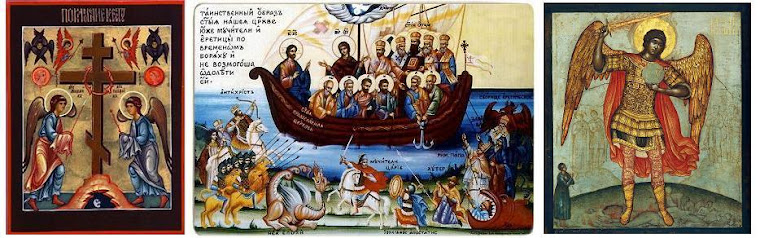
On Pride Saint John Climacus

Saint John Climacus. "The Ladder of Divine Ascent". Step 23.

Pride is a denial of God, an invention of the devil, contempt for men. It is the mother of condemnation, the offspring of praise, a sign of barrenness. It is a flight from God's help, the harbinger of madness, the author of downfall. It is the cause of diabolical possession, the source of anger, the gateway of hypocrisy. It is the fortress of demons, the custodian of sins, the source of hardheartedness. It is the denial of compassion, a bitter pharisee, a cruel judge. It is the foe of God, It is the root of blasphemy.
Pride begins where vainglory leaves off. Its midpoint comes with the humiliation of our neighbor, the shameless parading of our achievements, complacency, and unwillingness to be found out. It ends with the spurning of God's help, the exalting of one's own efforts and a devilish disposition.
Listen, therefore, all who wish to avoid this pit. This passion often draws strength initially from the giving of thanks, and at first it does not shamelessly urge us to renounce God. I have seen people who speak aloud their thanks to God but who in their hearts are glоrifying themselves, something demonstrated by that Pharisee with his "O God, I thank You" (Luke 18:11).
Pride takes up residence wherever we have lapsed, for a lapse is in fact an  indication of pride. And an admirable man said once to me: "Think of a dozen shameful passions. Love one of them, I mean pride, and it will take up the space of all the other eleven."
A proud monk argues bitterly with others. The humble monk is loath to contradict them.
The cypress tree does not bend to the ground in order to walk, nor does the haughty monk in order to gain obedience.

On Vainglory Saint John Climacus

Saint John Climacus. "The Ladder of Divine Ascent". Step 22.

Some would hold that vainglory is to be distinguished from pride, and so they give it a special place and chapter. Hence their claim that there are eight deadly sins. But against this is the view of Gregory the Theologian and other teachers that in fact the number is seven. I also hold this view. After all, what pride remains in a man who has conquered vainglory? The difference is between a child and a man, between wheat and bread, for the first is a beginning and the second an end. Therefore, as the occasion demands, let us talk about the unholy vice of self-esteem, the beginning and completion of the passions; and let us talk briefly, for to undertake an exhaustive discussion would be to act like someone who inquires into the weight of the winds.
From the point of view of form, vainglory is a change of nature, a perversion of character, a taking note of criticism." As for its quality, it is a waste of work and sweat, a betrayal of treasure, an offspring of unbelief, a harbinger of pride, shipwreck in port, the ant on the threshing floor, small and yet with designs on all the fruit of one's labor. The ant waits until the wheat is in, vainglory until the riches of excellence are gathered; the one a thief, the other a wastrel.
The spirit of despair exults at the sight of mounting vice, the spirit of vainglory at the sight of the growing treasures of virtue. The door for the one is a mass of wounds, while the gateway for the other is the wealth of hard work done.
Watch vainglory. Notice how, until the very day of the burial it rejoices in clothes, oils, servants, perfumes, and such like.