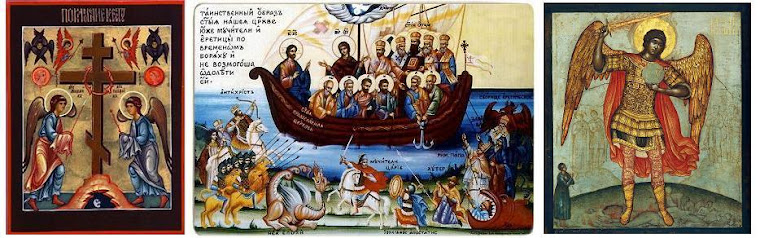
Metropolitan Anthony (Krapovitsky). "Confession".
10. Spiritual Delusion (Prelest).

Weak faith and carelessness are expressions of people’s irreligion, but even a pious person is not protected from spiritual sickness if he does not have a wise guide, either a living person or a spiritual writer. This sickness is called prelest, or spiritual delusion, imagining oneself to be near to God and to the realm of the divine and supernatural. Even zealous ascetics in monasteries are sometimes subject to this delusion, but of course, lay people who are zealous in outward ascetic struggles undergo it much more frequently. Surpassing their acquaintainces in feats of prayer and fasting, they imagine that they are seers of divine visions, or at least of dreams inspired by grace. In all events in their lives they see special, intentional directions from God or their Guardian Angel, and then they start imagining that they are God’s elect, and not infrequently try to foretell the future. The Holy Fathers armed themselves against nothing so fiercely as against this sickness — spiritual delusion.
Prelest endangers a man’s soul if it lurks in him alone; but it is dangerous and imperilling also for the whole of local church life, if a whole society is seized in its grasp, if it makes its appearance anywhere as a spiritual epidemic and the life of a whole parish or diocese is oriented entirely towards it. This is exactly what has happened in the Russian Church, both in Great Russia and in the Ukraine, both among the simple people and in the so-called "enlightened society." This plague, under various names, began to develop in strength throughout the local Russian Church some thirty years ago, and by the time of the last war it had seized almost all parts of the former Russian Empire in its grasp. In St. Petersburg, in Moscow and on the lower reaches of the Volga appeared the Johannites, who declared the late Fr. John of Kronstadt to be a reincarnation of Christ and a certain Matrona Kisileva to be the Mother of God. To replace one Christ, others appeared — Chursikov in Petrograd, Koloskov in Moscow and Samara, and so on. The Ukraine created Stephan Podgorny, a wanderer who later became a monk and claimed to be God. Podolia and Bessarabia declared a semi-literate and drunken Moldavian hieromonk, Innokenty, to be Christ. In Kiev another uneducated monk called Spiridon, who had attained to the rank of archimandrite during the war, started to preach a new faith. In Siberia Johannism took on an especially fanatical character, and, alas, even on Mt. Athos an extremely harmful movement of delusion, called imenobozhnichestvo, has started spreading.
Prelest endangers a man’s soul if it lurks in him alone; but it is dangerous and imperilling also for the whole of local church life, if a whole society is seized in its grasp, if it makes its appearance anywhere as a spiritual epidemic and the life of a whole parish or diocese is oriented entirely towards it. This is exactly what has happened in the Russian Church, both in Great Russia and in the Ukraine, both among the simple people and in the so-called "enlightened society." This plague, under various names, began to develop in strength throughout the local Russian Church some thirty years ago, and by the time of the last war it had seized almost all parts of the former Russian Empire in its grasp. In St. Petersburg, in Moscow and on the lower reaches of the Volga appeared the Johannites, who declared the late Fr. John of Kronstadt to be a reincarnation of Christ and a certain Matrona Kisileva to be the Mother of God. To replace one Christ, others appeared — Chursikov in Petrograd, Koloskov in Moscow and Samara, and so on. The Ukraine created Stephan Podgorny, a wanderer who later became a monk and claimed to be God. Podolia and Bessarabia declared a semi-literate and drunken Moldavian hieromonk, Innokenty, to be Christ. In Kiev another uneducated monk called Spiridon, who had attained to the rank of archimandrite during the war, started to preach a new faith. In Siberia Johannism took on an especially fanatical character, and, alas, even on Mt. Athos an extremely harmful movement of delusion, called imenobozhnichestvo, has started spreading.
